The Australia Chair of the US think tank the Center for Strategic and International Studies (CSIS) recently released an interactive map visualising the security relationships between Pacific Island countries and Australia, the United States, New Zealand, China, and Taiwan.
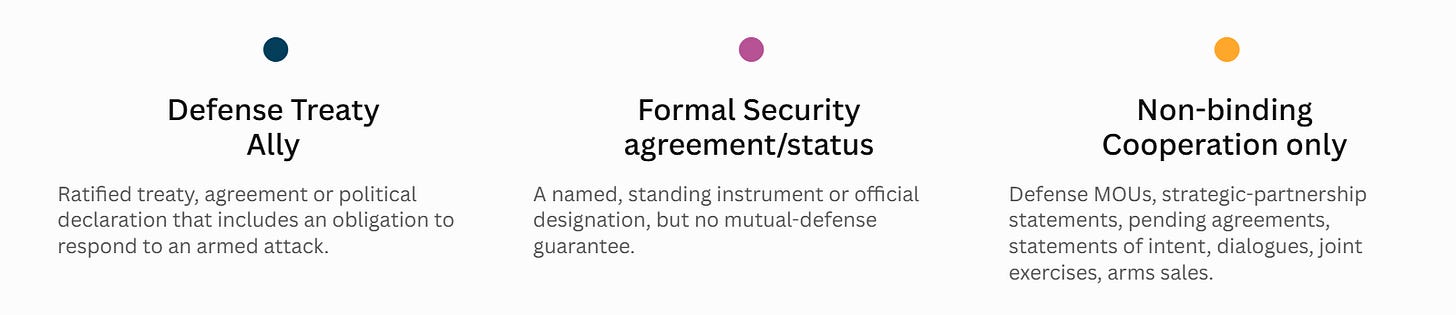
One notable part of this which stood out to me is the way it clearly categorises and distinguishes between the different kinds of partnerships present in the Pacific. As someone who studies alliances and defence treaties, this resonated with some wider thoughts I’d been having on this very topic.
An agreeable taxonomy of security agreements
I won’t pretend that my academic tendencies aren’t showing here, but it’s important to begin with a discussion of definitions. The terminology and classifications researchers and governments use about security partnerships often get muddled, but one of the strengths of this resource is that it seeks to cut through some of that to provide a general overview of the partnerships present in the Pacific.
A quick examination of the academic record will show that there is no shortage of debate on where to draw the line on treaty alliances, temporary alliances, ententes, mutual defence treaties, security partnerships, and more. The same issue can be even worse when it comes to the proliferating array of Strategic Partnerships, Comprehensive Strategic Partnerships, Special Strategic Partnerships, Enhanced Vice-Regal Sub-Regional Temporally-Bounded Fraternal Partnerships…
For example, while I like the functional categories CSIS has drawn up here, all treaties are essentially non-binding forms of cooperation (more on that below), and all alliances are formal security agreements. That makes it tricky to land on an agreeable taxonomy without exhaustive explanatory detail, but if we focus on the definitions offered here instead of titles, this resource lays out a neat triptych—even if it does raise questions about what constitutes an ally in the minds of the governments in question.
Alliances, defence treaties, and “conscious coupling”
To appropriate a phrase from Gwyneth Paltrow and Chris Martin, alliances are a process of conscious coupling. They’re formal, legal agreements embodied in treaties, setting out mutual commitments and understandings. However, they’re not the sum total of that relationship, and they contain a raft of escape clauses in the event that there are disagreements or unaligned preferences between the parties.
As much as the underlying dynamics of international politics remain constant, the conduct of interstate relations have certainly become shaped far more by international law, covenant, and treaty in the post-Second World War era. That means that understanding and explaining what an alliance means in practice becomes quickly steeped in legal and diplomatic technical language, hence the fights over semantics.
No definition is perfect, but the key principles of a contemporary diplomatic and strategic understanding of alliances is that they are between two or more states, formalised through a treaty, and they coordinate military or strategic policy towards common ends, including a commitment to support each other in the event of a threat to their security.
This does raise some strange exceptions, though. Australia and the United Kingdom are not allies, for instance, even though it seems improbable that each would not provide some measure of military support to the other in the event of a crisis. I think it’s fair to describe the two countries as functional allies, but not formal allies, seeing as there is no underlying security treaty or mutual defence pact.
Likewise, neither the AUKUS trilateral security partnership nor the Five Eyes intelligence-sharing partnership are alliances—though they contribute to military capabilities—as there is no security commitment between the parties.
You might also think about wartime allies such as in coalitions or ententes, which entail fighting together in pursuit of shared military objectives, but they lack the treaty-based formality, and are generally more temporally-bounded (i.e. for the duration of the conflict) than an alliance.
Another point of confusion is that the United States uses the term ally much more loosely than we would in Australia, with that label applying to not only treaty allies but a wide array of Major Non-NATO Allies (MNNAs) with whom the US may or may not have a formal alliance.
The Australian government has been typically very disciplined on this point of language, but CSIS’ categorisations highlight some interesting details of Australia’s expanding network of Pacific security pacts.
Only four allies are recognised in the CSIS visualisation: the United States, New Zealand, Papua New Guinea, and Fiji. Separately though, Australia effectively guarantees the security of Naoero and Tuvalu—marked here as “Defence Treaty All[ies]”. In official Australian diplomatic lingo though, they’re not allies, but I think they are correctly placed in the highest tier of partnership in this visualisation.
[As a brief aside, a couple of agreements out of CSIS’ scope but which I would include in this tier are the Five Power Defence Agreements, the Australia-Japan Joint Declaration on Security Cooperation, and the Jakarta Treaty. I’ll write more on those at a later date.]
Naoero and Tuvalu: more than friends, not yet allies
Australia’s treaties with Naoero and Tuvalu both contain security commitments, but of two different types. The Nauru-Australia Treaty incorporates a consultation clause, which states that:
In the event of a development that threatens the sovereignty, peace or stability of either Party, the Parties shall mutually consult and consider whether any measures should be taken, including the provision of mutually agreed support from Australia.
Beyond this, there is a second—and more wide-ranging—form of consultation inherent in the treaty:
Nauru shall mutually agree with Australia any partnership, arrangement or engagement with any other State or entity on matters relating to Nauru’s security including maritime security, defence, policing, border protection and cyber security sectors, and Nauru’s critical infrastructure concerning banking and telecommunications.
Nauru shall consult with Australia on any partnership, arrangement or engagement with any other State or entity relating to Nauru’s other critical infrastructure such as ports, aviation, and energy infrastructure.
In the case of the Falepili Union, the implied strength of commitment is even greater. It is not even a question of consultation, but a commitment to act in response to a request by Tuvalu:
Australia shall, in accordance with its international law obligations, international commitments, domestic processes and capacity, and following a request from Tuvalu, provide assistance to Tuvalu in response to:
(a) a major natural disaster;
(b) a public health emergency of international concern;
(c) military aggression against Tuvalu.
As with Naoero, the Falepili Union also gives Australia substantial additional privileges relating to Tuvalu’s security:
In addition to the Parties’ rights and freedoms under international law, provided that advance notice is given by Australia, Tuvalu shall provide Australia rights to access, presence within, and overflight of Tuvalu’s territory, if the activities are necessary for the provision of assistance requested by Tuvalu under this agreement.
Tuvalu shall mutually agree with Australia any partnership, arrangement or engagement with any other State or entity on security and defence-related matters. Such matters include but are not limited to defence, policing, border protection, cyber security and critical infrastructure, including ports, telecommunications and energy infrastructure.
What is absent here, but present in all of Australia’s formal alliances, is a mutual commitment to act. Apart from a slightly extended clause in the ANZUS Treaty (shown below in square brackets), the security commitment is identical in each of the ANZUS, Pukpuk, and Veitacini Treaties:
Each Party recognizes that an armed attack in the Pacific [Area on any of the Parties] would be dangerous to its own peace and safety and declares that it would act to meet the common danger in accordance with its constitutional processes.
This is also comparable with Article 5 of the Washington Treaty, which underpins the North Atlantic Treaty Organisation—often regarded as the gold standard of contemporary military alliances and legal security guarantees—but again, that’s a topic for another day.
Still struggling with solutions for security semantics
Thank you if you’ve made it this far, but to close off this thought for now, a significant challenge in analysing alliances and security frameworks is that it quickly descends into legalistic-diplomatic semantics. They’re necessary discussions to make sure it’s a valid comparison, but I’m quite sure they’re not invigorating for a general audience.
There’s no neat solution to this, but it does highlight the challenges in conducting comparative analyses between different security pacts, treaties, alliances, partnerships, and frameworks.
Hopefully this helps a little in making those differences explicable, and again, well done to the CSIS team for really useful and clearly-presented piece of work.


Leave a Reply